please view on a computer, not a phone!

A Sense of Scale: A Creative Art Story of Time and Space
Click play on the video to the left. A scene-by-scene analysis follows below the video.
Scene-By-Scene Analysis
We begin with a view of the multiverse, where each dark sphere is a separate, parallel universe.
Each universe was created by a statistical fluke. A mere chance that, within all the disorder, order was formed. Some universes are at different stages of disorder than others. Some, for now, are highly ordered.
Zooming in, we see a particular universe that has highly ordered structures.
Galaxies and further galaxy clusters appear, formed by the snowballing effect of gravity. One particular galaxy leads us to an unexpected place: the Library of Babel.
This infinite library contains an entire infinite universe in itself.
The endless shelves of 410-page books contain every single possible combination of letters, providing every single articulable truth. Staircases wind and lead to new pentagonal sections filled with more books.
Finding books with order that we can read and understand — with meaning — is rare.
One such book happens to present itself and describes the curiosities of time through different world clocks, inspired by Alan Lightman's Einstein’s Dreams.
In one world, time ticks backwards from XII to I. In a different world, time loops — 1, 2, 3, 1, 2, 3, and so forth. In another, time accelerates faster and faster — I, II, IV, VIII, XVI, and on.
One world does not measure time as we are familiar with. Its clock has several hands, where “now” jumps from time to time in a jumbled chaos of moments.
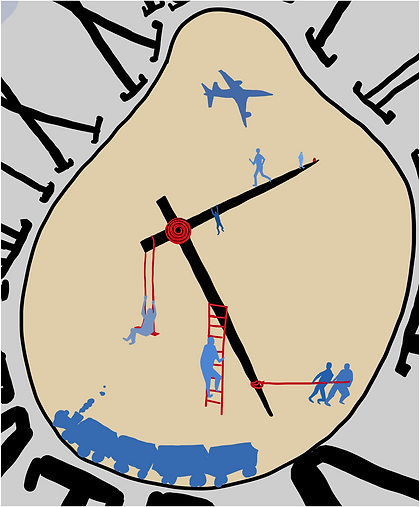
However, a closer look at another particular clock shows features of a linear time that we are familiar with.
Within this world, we see a society bound by the limits of time.
Some beings try to stop the hands of the clock from ticking in an endless struggle of tug of war. Some try to understand time and take a closer look at how the clock ticks. Some spend it at leisure — playing and recreating — while others cannot face the idea that their lives will end and try to hold on or run away.
All the while, economies and industries continue, unaware of their absurdity and meaninglessness.
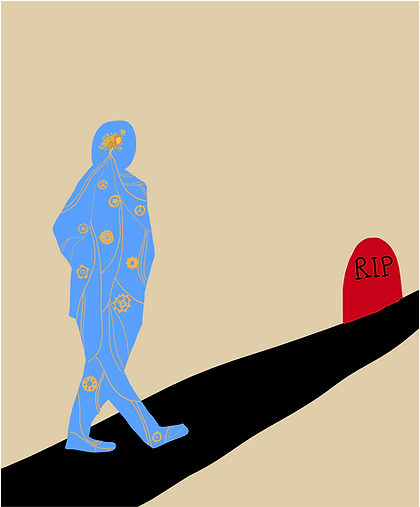
Our journey takes us to one particular being, whose existence is ending.
This being, though they feel alive and free, is truly mechanistic — made up of gears and wires.
Inspired by Ted Chiang’s Exhalation, we see that the being’s brain is no different from their body. It is also made of gears and wires.
Their consciousness arises purely from the arbitrary movement of golden leaves, fluttering in gusts of air.
The being’s free will is no more than just a false notion. Instead, pure laws of physics guide every decision, movement, and thought.
Within this brain, we pinpoint a particular atom, where we find electrons zooming around a nucleus, like planets orbiting a sun.
But a closer look into one electron reveals a shocking realization: we are back where we began this journey.
Within every single electron in this atom, there is a different glimpse into the same multiverse from which we started.
In this journey, we have explored a singular “now slice” which captures a glimpse of just one universe at a specific moment in time.
And within every frame, there exist seemingly endless pathways to different realities — different universes, galaxies, library books, clocks, beings, minds, and atoms — but does it really matter?
Eventually, this universe, like all others, will fall to disorder, and all we saw will cease to exist.




I would like to acknowledge the works of Erik Desmazières for providing heavy inspiration for my illustration of the Library of Babel, as well as the Powers of Ten (1977) short film by Charles and Ray Eames for the concept of absurd scale and the idea of zooming in and out through space.
Additionally, the following authors have inspired or been referenced in this work:
Alan Lightman, “Einstein’s Dreams” (1992)
Jorge Luis Borges, “The Library of Babel” (1941)
Robert Nozick, "Philosophy and the Meaning of Life” (1981)
Ted Chiang, “Exhalation” (2019)
Thomas Nagel, “The Absurd” (1971)
And, of course, thank you to Brian Greene for this course in which I gained a deeper glimpse into the absurd world we live in.